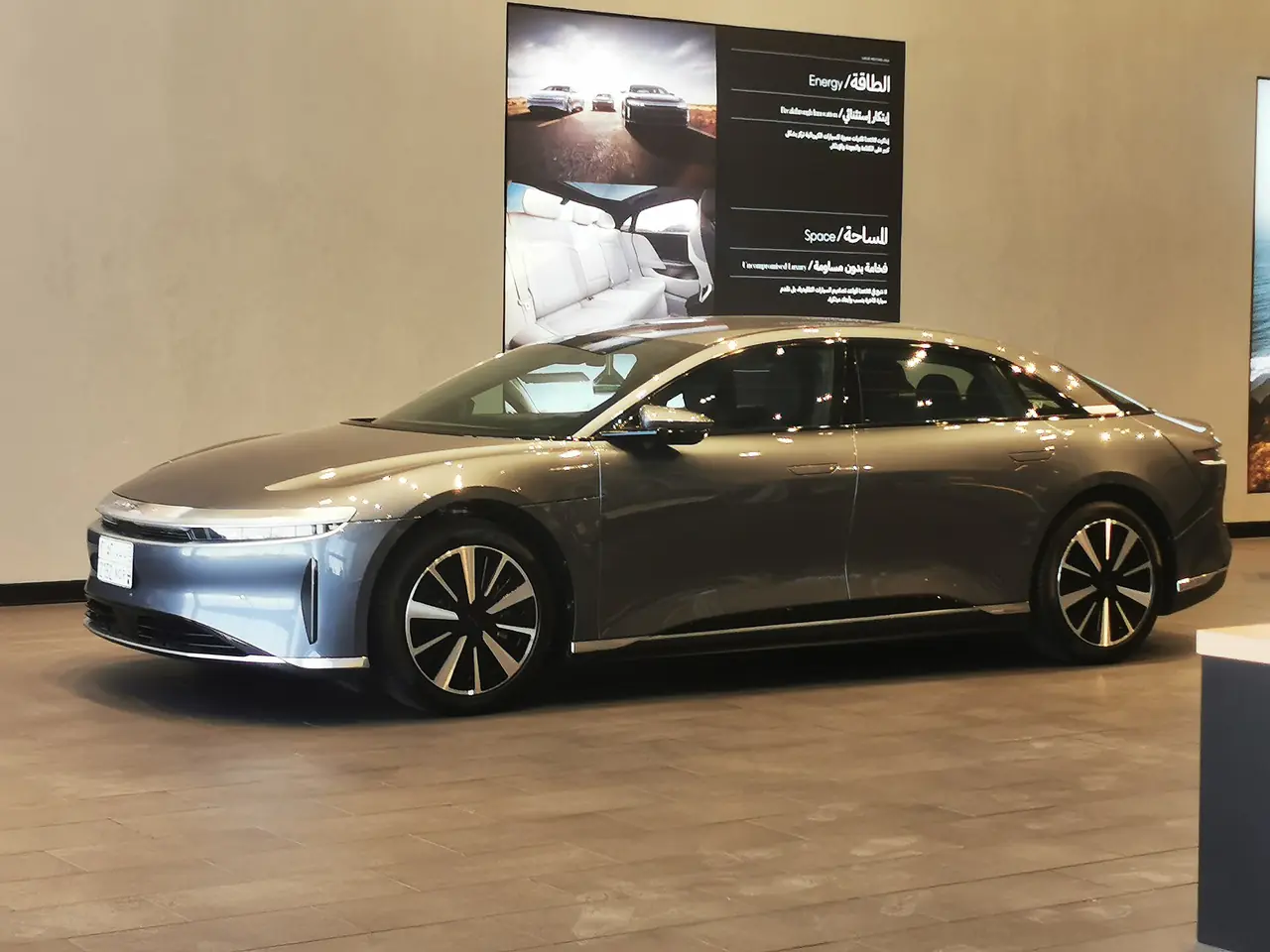
2027, not battery size, horsepower, or range, is the most important Lucid Cosmos specification we have right now. Multiple reports say Lucid’s smaller midsize EV, previously expected sooner, has been pushed into 2027. InsideEVs quoted Lucid CEO Marc Winterhoff saying the company “will not repeat the mistakes of the past by bringing a product to market before it is ready.”
That sentence is the reveal underneath the reveal. The Cosmos is not just another Lucid body style. It is Lucid’s first serious attempt to compress its efficiency and premium-EV identity into a smaller, cheaper, higher-volume product. Carscoops describes it as a sub-$50K model delayed as part of a broader operational reset. Electrek reports the vehicle had been slated for 2026 and is now pushed back to 2027. Car and Driver says Lucid has shown new Cosmos images with a sloping roofline, while a sportier Gravity is expected sooner.
Reported fact: Lucid has not published the Cosmos battery pack, motor output, EPA range, charging curve, curb weight, or final price. Field Signal read: that makes the launch timing more important, not less. A midsize EV is where Lucid can no longer hide behind halo-car logic. The Air could be expensive because it chased range and performance. The Gravity can carry a premium because it is a large SUV. The Cosmos has to make the expensive Lucid stuff — efficiency, cabin interface, charging behavior, noise isolation, thermal control — work with a harder bill of materials.
That is a different engineering problem from building a flagship. A lower-cost Lucid does not simply need fewer features. It needs fewer parts that feel like fewer parts. It needs a trim walk that does not create factory chaos. It needs software that is complete at handover, not promised through a future OTA. It needs charging handshakes that work outside the press-fleet bubble. It needs service procedures, replacement parts, diagnostics, and owner education ready before the first wave of customers becomes the validation fleet.
This is why the delay matters to operators. A car launch is not one date; it is a chain of frozen decisions. Design release, supplier tooling, validation mileage, software branch stability, manufacturing work instructions, dealer or service-center readiness, parts catalog accuracy, customer-support scripts, charging-data triage — all of that either gets done before Job One or gets done by angry owners afterward. Lucid’s CEO line is notable because it points to a gate, not a vibe: readiness before market entry.
The enthusiast risk is obvious. Waiting costs oxygen. The midsize EV segment will not pause for Lucid. Every month gives rivals more time to improve range, charging access, ADAS behavior, and interior software. But launching an unfinished smaller EV would be worse, because Cosmos buyers will be less tolerant of flagship-car excuses. A driver spending less than Air money still expects the car to boot cleanly, route intelligently, charge predictably, and feel like the same company that built Lucid’s reputation for efficiency.
There is also a packaging tell in the way Car and Driver describes the teaser: a smaller EV with a sloping roofline. If that shape survives into production, Lucid is choosing aero and identity over a pure box-max utility play. That can be the right Lucid move, but only if the usable package, rear-seat space, cargo opening, sightlines, and thermal efficiency justify the silhouette. A pretty roof is cheap in a teaser and expensive in a customer clinic.
Field Signal’s read: the Cosmos delay is Lucid choosing product discipline over announcement velocity. That is less glamorous than a range number, but it is exactly the decision a smaller EV needs. The car that matters is not the one Lucid can show. It is the one Lucid can build repeatedly, update safely, service quickly, and hand to normal drivers without turning them into unpaid test engineers.
If Cosmos arrives in 2027 with unfinished software, confusing trims, fragile launch quality, or a compromised package, the delay will look like lost time. If it arrives as a genuinely coherent small Lucid — efficient, quiet, sorted, and easy to live with — then 2027 will have been the first good spec Lucid released.
Why it matters
The Cosmos is Lucid’s chance to prove its engineering identity can scale down. The delay signals that validation, software maturity, manufacturing readiness, and service workflow now matter more than being early.
Builder angle
For anyone building hardware, the lesson is launch gates. A lower-cost EV is not a cheaper flagship; it is a tougher systems problem because every part, option, software promise, and service procedure has less margin for drama.
What to watch next
Watch for Lucid to disclose the Cosmos platform details: battery chemistry and pack size, charging voltage, EPA range target, motor layout, production location, trim count, and what software features are standard at delivery versus OTA-enabled later.
Sources
- InsideEVs — Lucid delays midsize EV launch to 2027 Reports the 2027 delay and includes Lucid CEO Marc Winterhoff’s readiness quote.
- Electrek — Lucid’s smaller Cosmos SUV pushed back to 2027 Reports that the smaller Cosmos SUV, previously slated for 2026, has been pushed back.
- Carscoops — Lucid delays sub-$50K Cosmos as part of reset Frames the Cosmos as a sub-$50K model delayed during Lucid’s operational reset.
- Car and Driver — Lucid reveals new Cosmos images Reports new Cosmos teaser images, the sloping-roof design, and a sportier Gravity arriving sooner.