I forked and used OpenClaw a few months ago. So when I look at Instinct, Muse, and Grok Bot, a lot of this feels familiar. Give an agent context, connect it to tools, let it do things, and keep the conversation going.
But put a good interface around that and it’s kind of crazy what you start handing over.
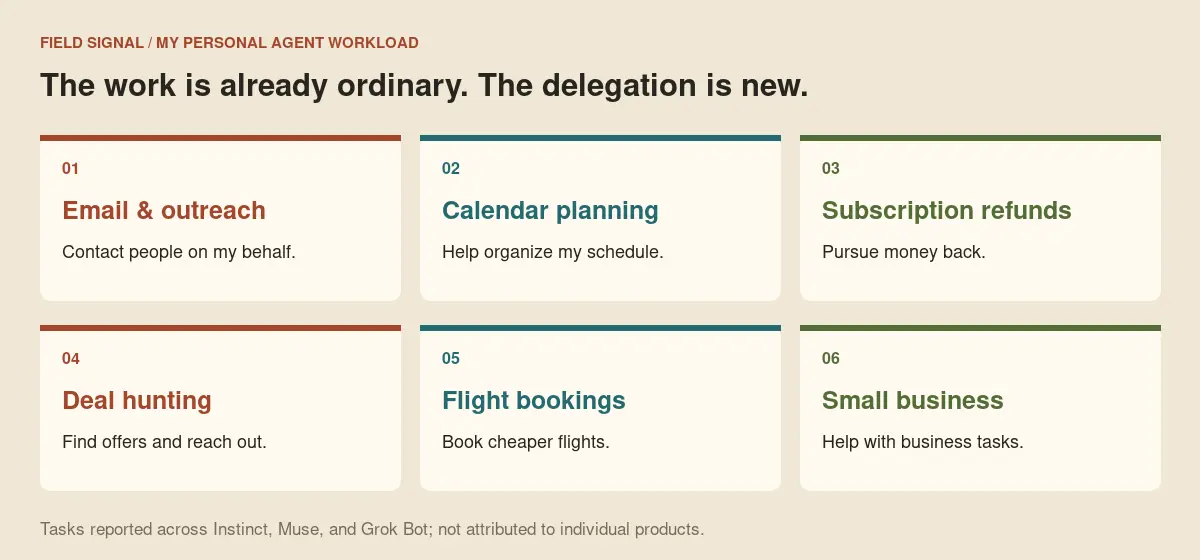
I have these agents emailing people for me. Planning my calendar. Getting money back from subscriptions. Reaching out and finding deals. They’ve booked me cheap flights, and I’m using them to help with my small business. That is where this has become interesting to me: the growing amount of ordinary work I can give them.
 Instinct
 Muse
Muse Grok Bot
OpenClaw made the idea familiar
My first reaction is that these feel like the OpenClaw idea packaged for more people. I mean that as a comparison of the experience; I haven’t established that these products use OpenClaw’s code.
OpenClaw already gives you an assistant connected to your tools and messaging channels, with persistent context and a choice of models. It runs on hardware you control. Forking it also lets you change the software itself. That is a different relationship with a product from signing into somebody else’s managed service.
I like being able to build and change things. I also want a refund handled and a flight booked. Sometimes I want to work on the agent. Sometimes I want to give it a job and get back to my day.
That’s why dismissing this whole category as “just a wrapper” misses something for me. The interface is where I explain what I want, connect an account, see what is happening, answer a question, and decide whether to let it continue. Those are substantial parts of using an agent.
What I’m actually handing over
Email is probably the clearest example. The agent is reaching out on my behalf. There is another person receiving that message, and sometimes a business relationship attached to it. That makes the handoff feel very different from asking for a paragraph of text.
Calendar planning, subscription refunds, and deal hunting each take a different kind of effort. One needs to understand my time. Another needs to pursue an outcome through a support process. Another needs to keep looking until there is something worth bringing back. I’m using agents across all of those.
And then there are the flights. They’ve booked me cheap flights. I still care about the dates, airports, baggage, and connections, but the fact that I can delegate the job at all is useful. Travel has plenty of small decisions that can eat up an evening.
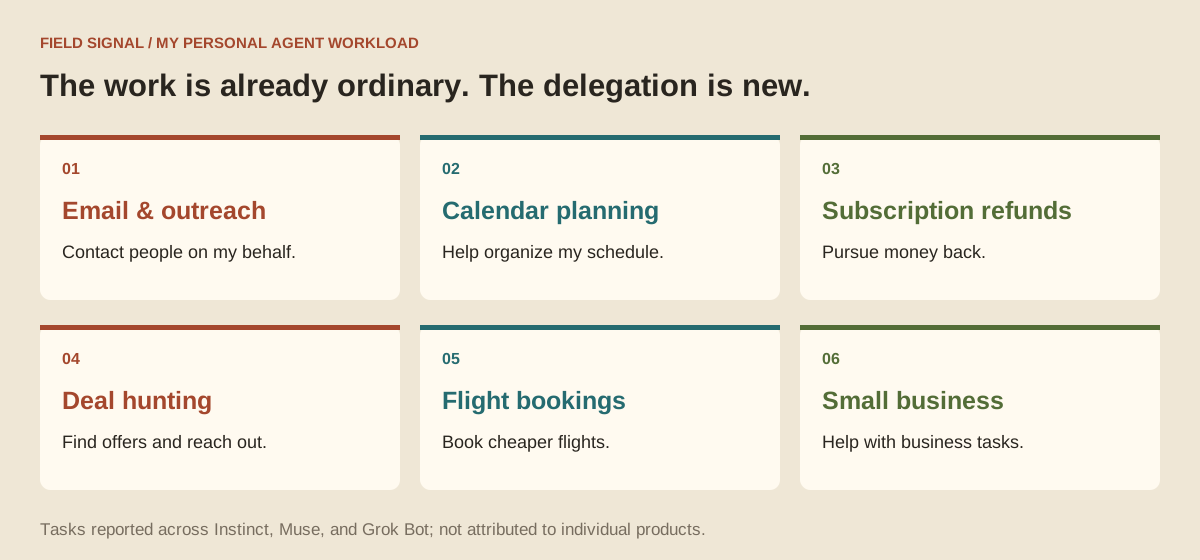
The small-business side makes this even more relevant. Emails, outreach, scheduling, and searching for options can sit between me and the work I actually need to finish. Having help with those tasks matters. I haven’t measured the time saved yet. I can point to the work I’m already handing over.
What each product actually gives you
I pulled the public specifications because similar-looking conversations can sit on top of quite different systems. These are documented capabilities as of September 29, 2026; my experience above spans the three products without assigning each task to a particular one.
Instinct
A personal assistant you message.
- Interface
- Text-based interaction. Calling is not counted here as a verified, generally available feature.
- Connections
- Email, messaging, screen, audio, location, and other applications and devices.
- Ongoing work
- Proactive messages and follow-ups on unfinished threads.
- Calling availability
- The website advertises calls, but does not establish who has access or which calling modes are supported. That is not enough to list it as a standard capability.
- Model
- A “core model” is described; no model identifier is given on the public page.
- Price & limits
- No public price or usage allowance on the page reviewed.
- Technical visibility
- VM isolation, credential handling, and detailed approval rules are not specified there.
Muse
A personal agent with a dedicated cloud computer.
- Interface
- Muse app and WhatsApp; web, iOS, Android, and a Mac app.
- Runtime & model
- Persistent Secure VM and browser; powered by Muse Spark.
- Connections
- Email, calendar, Instagram, and additional connectors. Works in the background.
- Approvals
- Allow once, always allow, or deny; activity history. A separate Sentinel checks outgoing actions.
- Credentials & payments
- Credential store hidden from the agent; Link uses one-time card numbers. 1Password support is announced as coming soon.
- Price & limits
- Free with usage limits; paid upgrades. Exact paid rates are not listed on the page reviewed.
Grok Bot
Named bots with continuing jobs and shared tools.
- Interface
- Text, dictation, voice; macOS, Windows, Linux, iOS, and Android in the documentation.
- Runtime
- One persistent cloud computer per account: browser, filesystem, terminal. Bots share files and logins.
- Ongoing work
- Parallel bots, handoffs, memory, learned skills, and scheduled routines.
- Connections & control
- Connectors plus browser use. Approval requests and Auto Review for sensitive actions.
- Price & limits
- Included with eligible Cursor or SuperGrok plans. Listed entry plans: Cursor Pro $20/month; SuperGrok $30/month. Weekly usage included; additional usage costs extra.
- Model detail
- The plan page lists Grok 4.6; it does not establish a fixed model for every Bot task.
Vendor documentation, not independently measured limits or a benchmark. Instinct’s mascot is from its official site; Muse and Grok Bot icons are from their official App Store listings. Grok’s marketing page lists fewer platforms than its documentation; the platform row follows the documentation.
Instinct’s appeal is the most direct: message an assistant through channels you already understand. Muse puts a personal agent alongside connected apps, browser work, and explicit permission decisions. Grok Bot makes the idea of several ongoing workers more visible, with named bots, shared work, and routines.
That gives me a more useful way to look at them than trying to crown one winner. Do I want an assistant I can text? A place to manage personal goals and approve actions? Several bots with continuing jobs? The answer depends on what I’m handing over. The product cards describe those differences; they aren’t a performance ranking.
Good UI changes what I’m willing to delegate
“Good UI” can sound like I’m talking about nicer buttons. With agents, I mean something much more practical.
Can I tell it what I need without designing a workflow first? Is connecting an account understandable? Can I see whether it is working, waiting for me, or finished? When it asks for approval, can I understand exactly what happens next?
Those details affect whether I keep using it. If I have to reconstruct the whole task every time I open the app, I’m still carrying too much of it in my head. If I can give it context, leave, and come back to a useful result, I have a reason to hand over the next job.
A goal, dates, preferences, and a budget.
The accounts and tools the job needs.
What it will send, change, or buy.
What finished and what still needs you.
My experience with OpenClaw is why this stands out. I had already used the underlying idea. Now I’m seeing how much the way you interact with it can change its place in your day.
The responsibility still follows the account
I spend enough time thinking about agent access that I can’t ignore this part. An agent sending my email or spending my money needs clear limits. I want to know what it sent, what it booked, and what still needs me.
The interface can help make those decisions understandable. An approval screen needs to show the recipient, the action, or the purchase terms. The system underneath it still has to enforce the decision. A polished conversation alone doesn’t establish that.
That is also a reason to care about the specifications. Grok Bot’s shared computer means my bots share files and logins. Muse documents a separate Sentinel and credential storage. Instinct’s public page gives me less detail to inspect. Those differences deserve attention alongside how easy each one feels to use.
But the reason I keep coming back is simple: they’re helping. There are emails, refunds, bookings, and business tasks involved now. OpenClaw gave me an early way to explore this. These products are making me think harder about what happens when that experience becomes easy enough to use every day.
Field note: personal use and editorial opinion, with vendor specifications checked September 29, 2026. Prices and availability can change. Product marks belong to their respective owners.