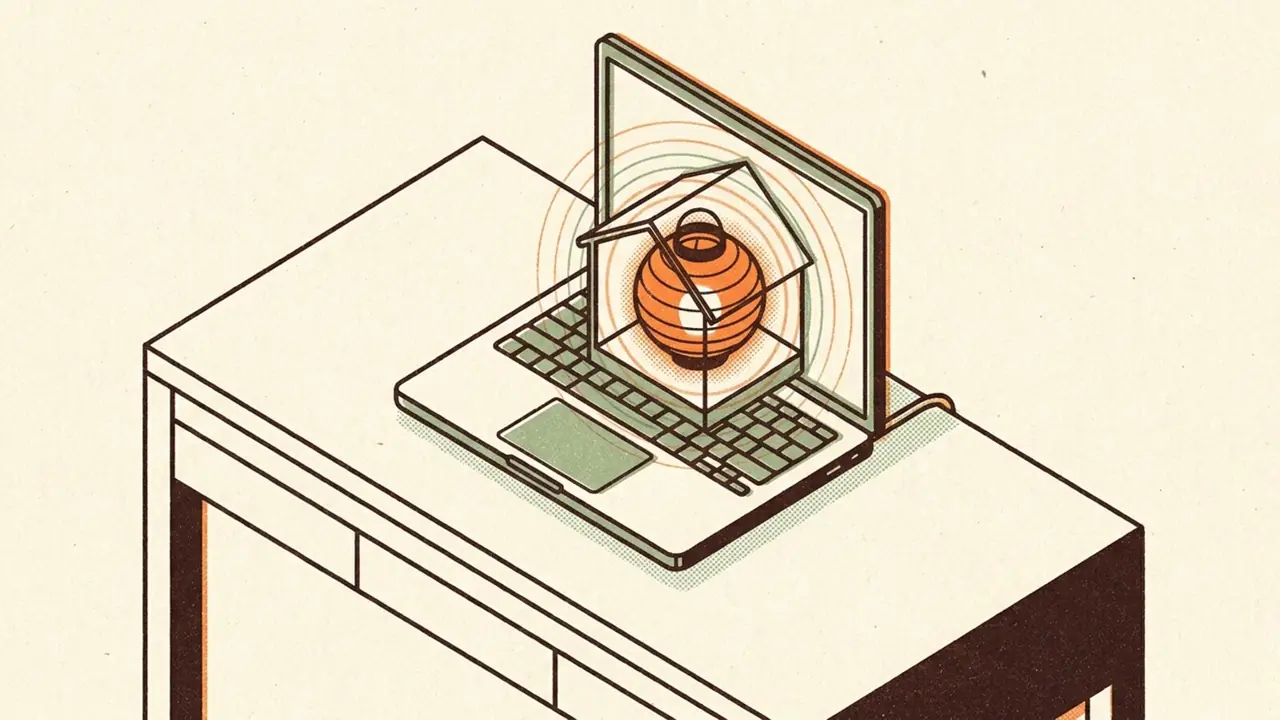
This week Meta open-sourced Muse Glimmer, a 30-billion-parameter model built to run on your own hardware. Most of the coverage led with the politics — Zuckerberg's essay, the shot at OpenAI and Anthropic, the U.S.-versus-China framing. That's the loud story. Here's the quiet one: I downloaded the thing, put it on my laptop, turned off the Wi-Fi, and it kept answering.
The specs matter for exactly one reason. Glimmer is a dense 30B model, Apache 2.0 licensed, with a 128,000-token context window. Quantized down to four bits, the weights come out to about 18 GB — small enough to sit in a laptop's memory with room to spare. That single number is the whole story: 18 GB fits, and the alternative doesn't.
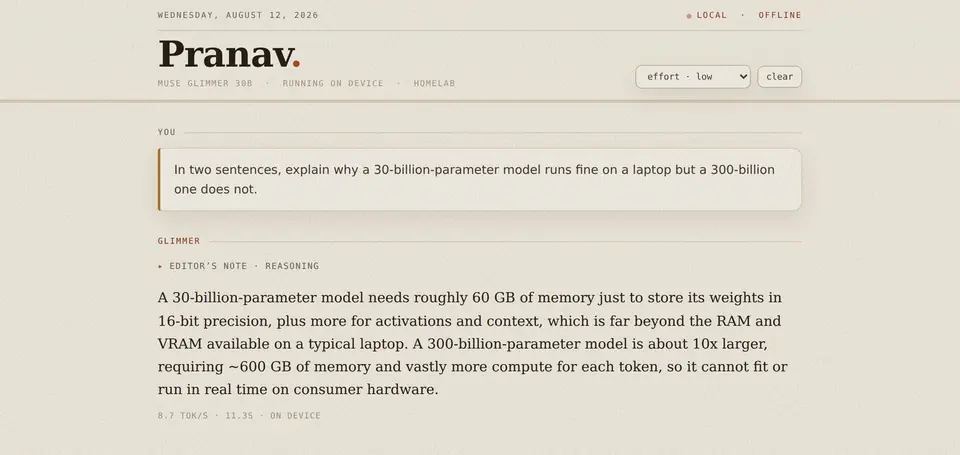
I asked the model to explain its own limits. A 30B model needs roughly 60 GB just to hold its weights at full precision; compress it to 4-bit and it drops to about 18 GB. Meta's larger model, Muse Spark, is nearly ten times bigger — around 150 GB even after the same compression. That one does not fit on any laptop. It is the clean line between “runs on your desk” and “rents a GPU by the hour.”
Setup was not friction-free, and this is a build log, so: the download alone was a saga. My laptop's connection was crawling for reasons I still haven't fully chased, and 18 GB that should have taken minutes was quoting eight hours. Then the ordinary local-AI papercuts — the wrong processor architecture for the Python I had, the wrong runtime library for a model only two days old. None of it was hard once I knew the shape of it. All of it was the tax you pay for being early.
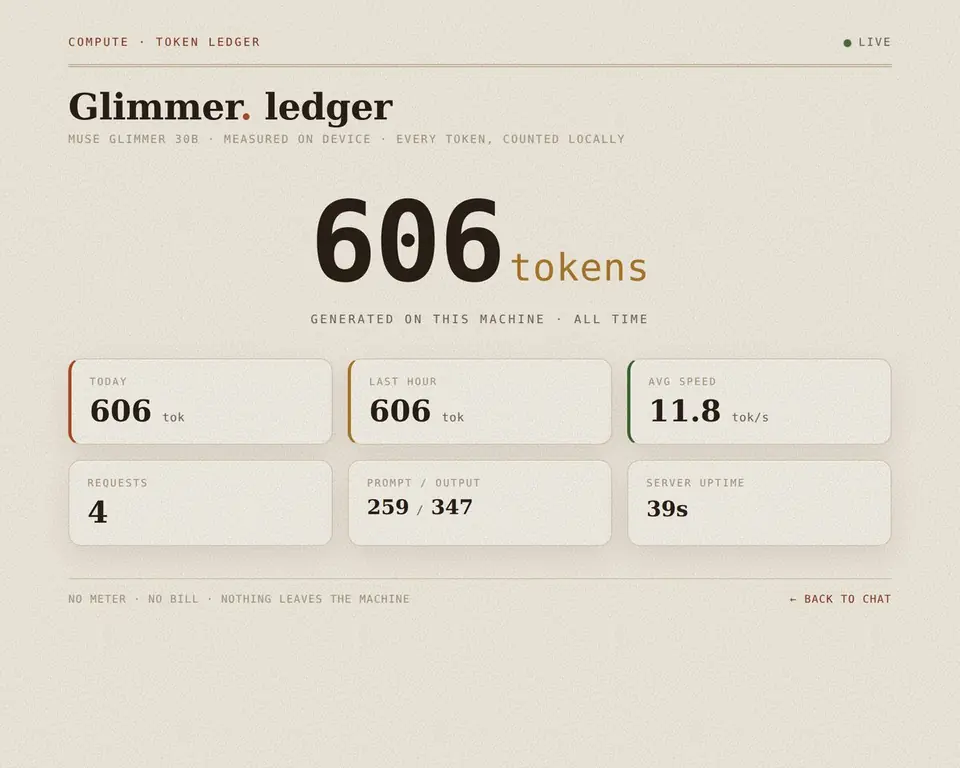
So what's it like to use? On this machine it generates about sixteen tokens a second — roughly a third the speed of the frontier APIs, but faster than I read, so a back-and-forth never feels like waiting. I handed it a real infrastructure problem I'd been stuck on and it walked to the right answer without help. It is not going to out-think Claude or GPT on the genuinely hard stuff, and I wouldn't ask it to. That isn't the point.
The point is the properties, not the IQ. What's new here isn't a smarter model — it's a useful one with a different set of constraints. Free, so I can run it in a loop all day without watching a meter. Private, so the prompt never leaves the machine. Offline, so it works on a plane or anywhere the network won't cooperate. Open-licensed, so it can go inside something I ship instead of being rented per seat. None of those are benchmark numbers. All of them change what you can build.
That last combination is the interesting one. The standard objection to putting AI anywhere sensitive — legal, medical, government, your own private notes — is that the data has to leave the building to reach the model. Glimmer inverts it. The model comes to the data. It runs behind your firewall, on your own metal, under your own rules, with no third party in the path. A year ago that demo needed a rack of rented GPUs. Now it fits in a backpack.
So I wired it up like infrastructure: a private endpoint on my own network, a small chat interface, and an API any of my tools can call. The plan is to route by difficulty instead of by habit — send the cheap, high-volume, or private work here, and save the frontier models for the problems that actually need them.
What I'm building next
A few directions from here. The first is speed — Meta ships a speculative-decoding trick that roughly doubles throughput, which would take this from readable to genuinely quick. The second is tools: letting the model propose an action and having my own code decide whether to run it, so it can do work instead of only answering — and still with nothing leaving the machine. It's also a vision model, so private, offline image understanding is on the list. Underneath all of it is the same habit: route the cheap, high-volume, and sensitive work to the model on my desk, and save the frontier APIs for the problems that truly need them.
Glimmer isn't the smartest model I used this week. It's the only one that kept working after I pulled the plug. Depending on what you're building, that can matter more than the last ten points of benchmark — and the open-weight models are now close enough to useful that “run it yourself” stops being a hobby and starts being an architecture decision.
References
- Meta AI Research — Introducing Muse Glimmer Meta's announcement and technical overview
- TechCrunch Coverage of the release and Zuckerberg's on-device vision
- VentureBeat Apache 2.0 licensing and agent optimization