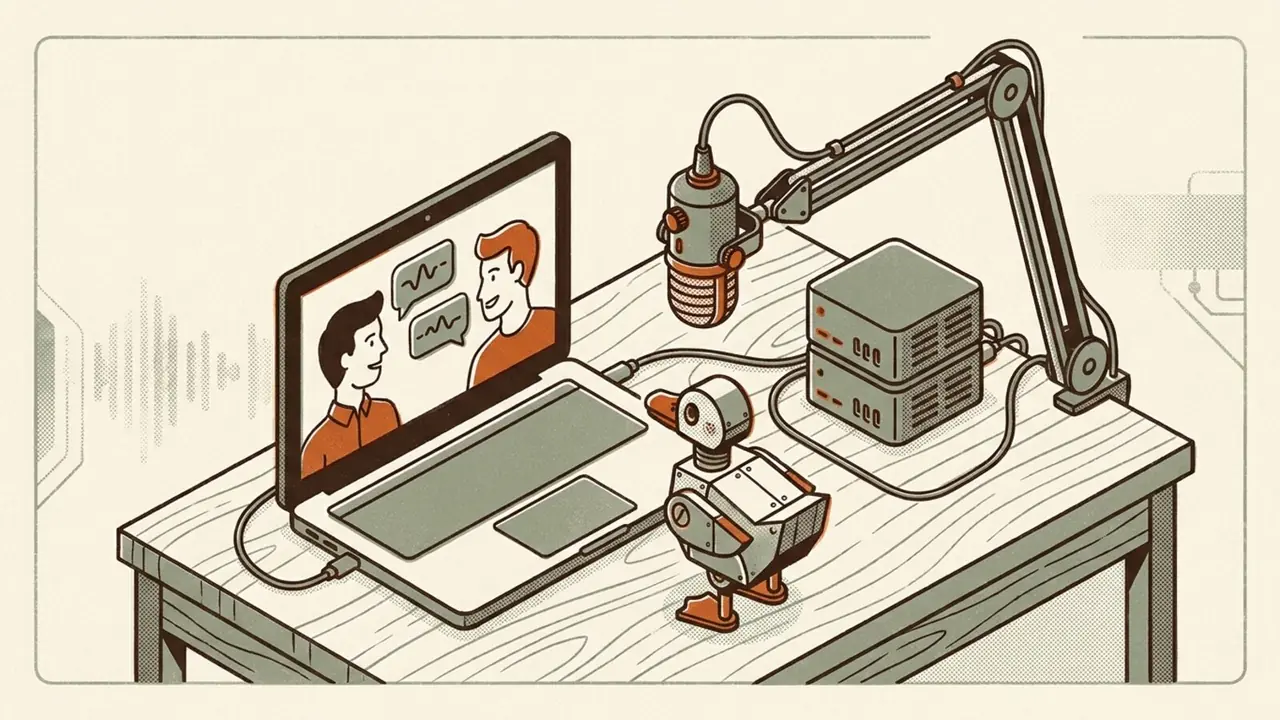
Niran and I both work at Broadcom, and for the last few months we've been trading notes on our home labs. He runs one DGX Spark. I run two. He suggested we just hit record and see if anyone wants to watch, so we did. Nothing was planned. It went up on his channel on November 7.
Here's what we talked about.
Why buy local AI hardware at all
Niran opened by asking the obvious question: why spend real money on a Spark when an API is cheaper? For me it's control. I can run small models and big ones, fine-tune when I want to, and everything stays in my house. I bought the second Spark because two of them can run the really big open models, like DeepSeek and GLM, using Mia AI's recipes.
The other reason is that I don't think today's subscription prices last forever. A maxed-out $200 coding plan is worth far more than $200 in API credits right now. It feels like the cheap Uber era of AI. I'm keeping my subscriptions, but I want hardware that's mine to fall back on. Niran pushed back on this: he thinks models will get more efficient and access will get cheaper, not pricier. We didn't settle that one.
This blog
Niran called Field Signal a very technical blog. I explained that it started because a friend told me to just put my lab work out there, even if one person reads it. It's meant to be a mix of a journal and a guide: something I can point someone at and say "this is exactly how I did it."
DeepSeek vs Qwen
Right now the Sparks run DeepSeek v4.1 Flash, at around 75 tokens a second. Compared with the Qwen model I started on, it makes fewer mistakes when coding. I'm in the middle of a side-by-side where both models build the same website, so that's a future post.
A fantasy football agent
This is the use case Niran wanted to dig into. I built a Hermes agent called DELPHI that manages my fantasy football team. It pulls player data, news and weather, sets my lineup, works the waiver wire, and texts me what it's doing. The whole point of that league is to see how well an agent does on its own, so I'm mostly just watching.
Niran asked the right question: how do you know it isn't making things up? Honestly, sometimes it does. It has gotten confused about which week it is. That's where I see the biggest gap between local and frontier models today. Local models are great at tasks and research, and frontier models are still better at actually thinking. Niran's suggestion was to stop being the validator myself and have a frontier model check the agent's work.
A Pokemon-style resume, built by a local model
That's pretty much how I built my personal site, pranavpatel.tech. It's my resume turned into a little Pokemon-style game: my high school, my college house, my job, my garage, my family's motel. GLM on the Sparks wrote the game, and Claude acted as the reviewer, finding bugs and sending fixes back for GLM to make. It took a full day instead of an hour, but most of it came from a model running in my house. There's an Easter egg in there too: find the stick of RAM and I'll buy you a coffee.
Sandboxing agents at home
On the enterprise side, I talked about my series on securing agents. Everyone's selling cloud sandboxes for agents right now. I built my own: a small, always-on micro VM in my lab, locked down with microsegmentation from vDefend, with AgentMinder keeping an audit trail of what the agent does.
Niran said this lines up with what he's seeing. Some organizations are already deep into agents, and what they're missing is standards: observability, audit trails, and keeping an agent inside its scope. He also explained why GPU efficiency matters so much at enterprise scale. Once GPUs are carved up per tenant, some sit at 10% while others are starved, and that's where virtualization helps.
A robot duck
Then we got to the fun part. After Jensen showed the micro duck at GTC Berlin, I wanted one right away, and the official one isn't shipping soon. So I'm building a replica from open-source designs. It uses different servos than the original, which means the walking policies have to be retrained. I used both Sparks to train the duck in simulation: it falls, gets up, and falls again for hours until it learns to walk. About $600 of parts are on the way, and then I need to print it and screw it together. Niran made me promise a follow-up video when it walks.
Why physical AI? AI is already making software work easier, and I think the next push is robots that take on repetitive or dangerous work, from picking up trash to search and rescue. I want to learn it now, before everyone else does. Nothing I learned about software in college applies anymore, so I'd rather keep learning.
Home robots and helping family
We looked at a home robot that does basic chores. Right now it has a remote human operator behind it, which is a little creepy. But we agreed that the first time one works fully on its own, we're both buying it.
I also have a Reachy Mini on wheels coming in December. The plan is a voice model that answers me in English, and answers my grandparents in Gujarati when they talk to it in Gujarati. Niran told a great story about his mother-in-law, who now uses a voice assistant every day in Russian, Hebrew and English, and even uses the camera to figure out where she is on walks. AI for older people is a huge use case.
What's overhyped
Niran's pick was personal assistants. They're great for technical people who know how to drive them, but they aren't there yet for regular people. And now sites are blocking agents from buying things for you.
Mine was Jev. It's a decision model, not a thinking model, and people are slapping it on everything. It's great when you give it real options and evidence, like cutting down an agent's looping. It's not going to pick the right model for a prompt with no context.
Who's responsible when an agent does something wrong?
We ended on accountability. Niran talked with a friend in legal at a big financial company. Their worry: if your agent opens an account or files a claim for you, and gets there in a way that crosses a line you never asked it to cross, who's responsible? Until there's an answer, a lot of companies are just saying no to agents. We didn't solve that one. It's a good thread for next time.
We're doing a follow-up, probably in person once the robots show up. And if you made it all the way through the episode, find the RAM stick on the pecan farm.
Thanks for having me, Niran. Go check out his work at niran.ai.