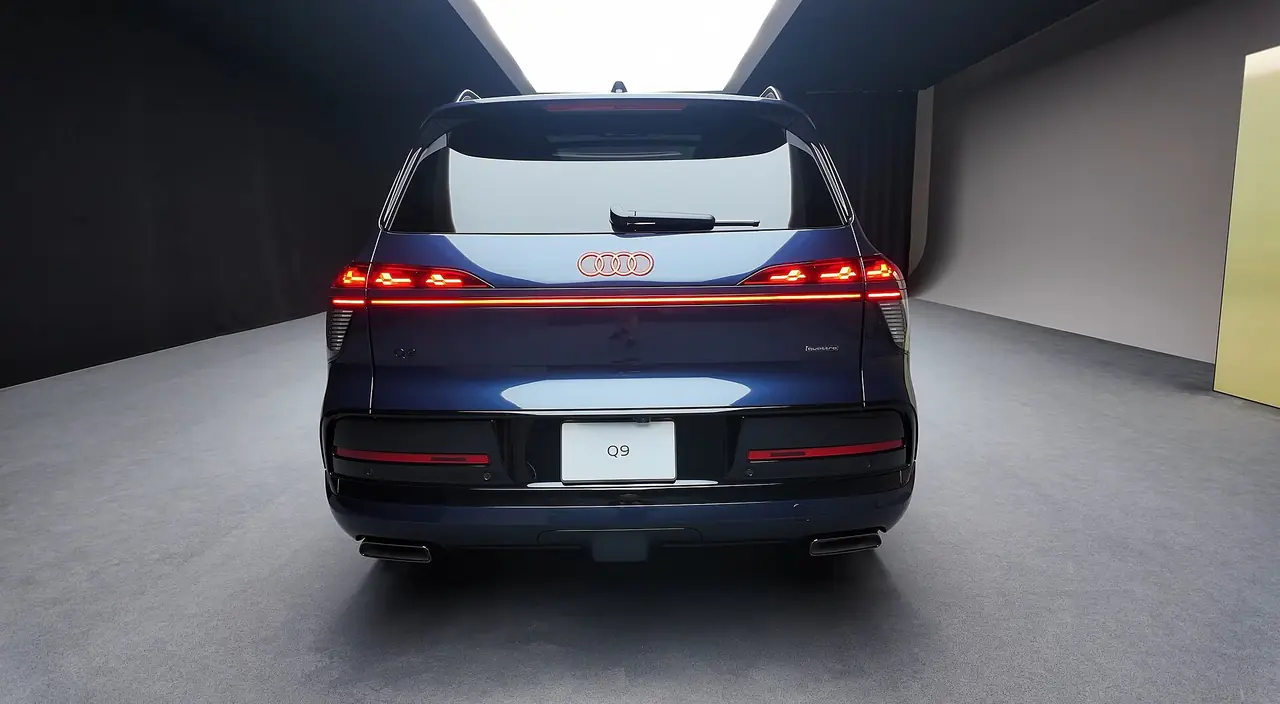
The 591-hp 2027 Audi SQ9 is the loud number, but the important number is row three. Audi has finally revealed the Q9 and SQ9 as its largest SUVs ever, entering the full-size three-row segment with a model positioned above the Q7. Car and Driver reports the Q9 arrives as Audi’s new flagship SUV, while The Drive describes it as larger than the BMW X7 and Mercedes-Benz GLS. Jalopnik notes the U.S. is the only market getting the V8-powered SQ9 with 591 horsepower.
That is the thesis hiding under the reveal: the Q9 is not Audi discovering big SUVs. It is Audi admitting the Q7 was never enough vehicle for the part of the market where width, cargo room, third-row dignity, and towing-adjacent confidence matter more than brand restraint. The SQ9’s V8 gives the enthusiast a hook, but the product decision is packaging first and performance second.
Reported fact: Audi now has a true full-size three-row flagship. Reported fact: the SQ9 sits above it as the performance version, with 591 hp in U.S. specification. Field Signal read: Audi is using the SQ9 to make the Q9 feel like an Audi rather than just a late answer to the X7 and GLS. Without that performance model, the Q9 risks being read as a stretched Q7. With it, Audi can sell the same cabin volume with a sharper identity: full-size utility, German-road-speed posture, and a familiar S-badge ladder for owners who refuse to drive the softest version of anything.
The uncomfortable part is that this is a concession. Audi’s older SUV hierarchy made a kind of European sense: Q5 for the center of gravity, Q7 for families, Q8 for style. The U.S. full-size luxury buyer does not shop that way. They cross-shop second-row captain’s-chair comfort, luggage space with all rows up, road-trip quiet, rear-seat screens, towing optics, and curb presence. The Q9 exists because a flagship SUV has to solve those physical problems before the chassis engineers get to be clever.
That changes the operator workflow around the car. Dealers now get a clearer three-row upsell instead of asking the Q7 to cover buyers who really wanted GLS/X7 scale. Product planners get room for a higher-margin S variant without forcing every Q9 customer into the same personality. Service teams get a more complex flagship with a performance drivetrain in the SQ9, which means the ownership experience has to be as polished as the showroom moment. The Q9 is a product-system car, not just a spec-sheet car.
For builders and tuners, the SQ9 is the one to watch because large performance SUVs live or die by heat management, tire load, brake durability, and calibration discipline. A 591-hp three-row Audi has to feel effortless with adults aboard, not just quick when empty. The challenge is not making a big SUV accelerate. The challenge is keeping steering precision, brake confidence, transmission logic, ride control, and cabin isolation from arguing with one another over 5,000-plus pounds of mission creep.
There is also a software-and-interface tell. Motor1’s close look at the Q9 described Audi pushing the model in a more flagship direction inside and out, while Car and Driver’s interior galleries show the expected screen-heavy luxury-SUV environment. Field Signal read: that cockpit has to serve two jobs at once. It must look expensive on delivery day, but it also has to keep common family-SUV tasks fast: climate, cameras, drive modes, rear-seat controls, phone handoff, trailer view if equipped, and navigation. The bigger the vehicle, the less tolerance owners have for menus that slow down routine use.
The Q9’s job is not to make Audi look radical. It is to stop making Audi look absent. The SQ9’s 591 hp gives the reveal its poster number, but the real engineering decision is that Audi finally built the box big enough for the flagship badge. That is less romantic than a high-revving coupe and more revealing than a concept car: in the biggest luxury segment, packaging is strategy.
If Audi gets the Q9 right, nobody will call it a stretched Q7 after the first airport run. If Audi gets it wrong, the SQ9’s V8 will only make the compromise arrive faster.
Why it matters
Audi has been strong in premium SUVs, but the Q9 changes the mission: it gives the brand a true full-size three-row flagship instead of asking the Q7 to fight vehicles built around American-scale space expectations.
Builder angle
The SQ9 is the engineering test case. A 591-hp three-row SUV needs cooling, brakes, tires, suspension calibration, and software UX that hold together under family-use weight, not just launch-control theater.
What to watch next
Watch U.S. specifications closely: seating layouts, cargo figures, towing ratings, wheel-and-tire packages, brake hardware, suspension options, and how much physical control Audi preserves for daily-use functions.
Sources
- Car and Driver Reveal coverage describing the 2027 Audi Q9 and SQ9 as the brand’s biggest SUVs, including the 591-hp SQ9.
- The Drive Reports the Q9 as Audi’s largest model and new flagship, positioned against full-size luxury SUV rivals.
- Jalopnik Notes the Q9’s three-row positioning and the U.S.-market V8-powered SQ9 with 591 horsepower.
- Motor1 Close-look reporting on the 2027 Audi Q9 and SQ9 reveal, including flagship positioning and design details.
- Car and Driver Interior gallery showing the Q9 cabin layout and screen-heavy flagship presentation.