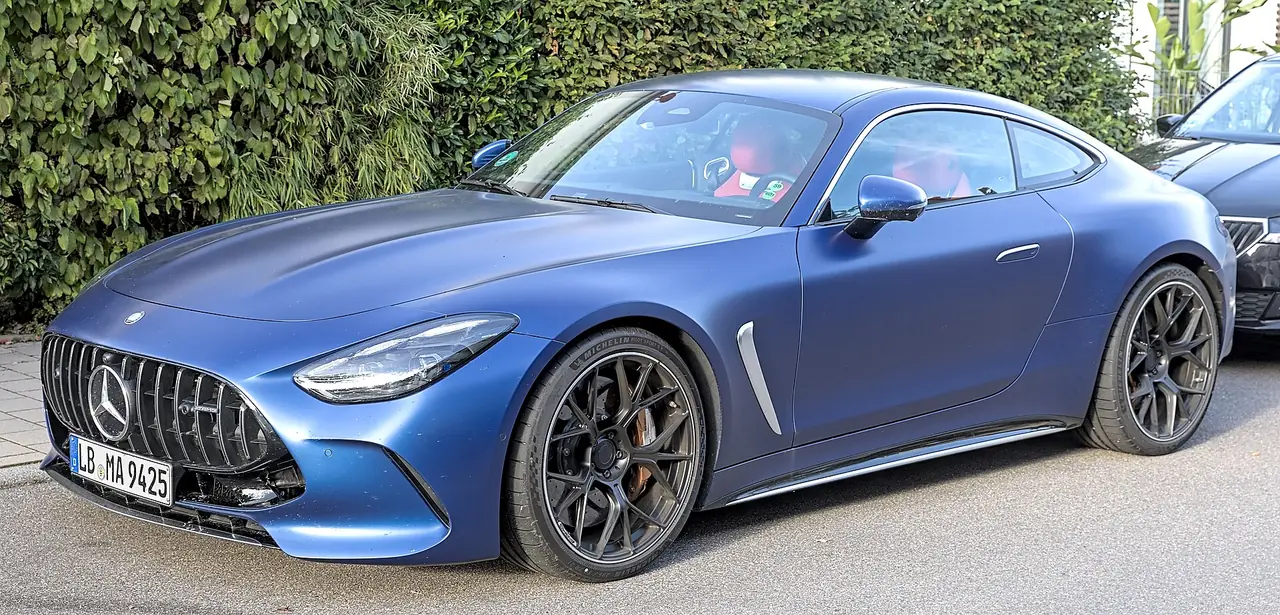
536 hp, two electric motors, and a claimed 3.8-second run to 60 mph: those are the numbers that make the 2027 Mercedes-AMG GT53 sound like a conventional entry trim. They are not the interesting part. The interesting part is what Mercedes-AMG removed.
Reported facts first: Car and Driver says the new GT53 is the lower-output version of AMG’s electric four-door GT family, sitting below the 1153-hp GT63. InsideEVs reports that the GT53 uses one fewer motor than the GT63, still makes 536 hp, and is tied to a range claim of more than 500 miles. Carscoops adds the other strange detail: AMG is giving this EV a straight-six-style soundtrack.
Field Signal read: this is AMG admitting that the first phase of performance EVs — add motors, add torque, add a hero acceleration number — is not enough to build a credible model ladder. The GT53 is not trying to win the garage argument against the GT63. It is trying to make the daily AMG EV feel expensive, quick, and usable without carrying the full hardware stack of the flagship.
That matters because motor count is one of the cleanest ways to separate an EV lineup. A third motor can buy traction authority, torque vectoring freedom, and a huge power headline. It also adds expensive hardware, mass, cooling demand, inverter capacity, control complexity, and calibration work. Mercedes-AMG choosing two motors for the GT53 is a packaging and product decision, not just a marketing downgrade.
The range claim is the tell. AMG could have made the GT53 another acceleration-first electric sedan with a smaller brag number than the GT63. Instead, the published story is 536 hp plus more than 500 miles of range. Range figures depend on test cycle and final market certification, so do not read that as an EPA promise. Read it as intent: AMG wants this trim judged by sustained usefulness, not only launch-control theater.
Then comes the awkward part: the straight-six sound. A synthesized engine note in an EV can feel like cosplay if the rest of the car has no mechanical reason to behave like the thing it is imitating. But it also exposes where software-defined performance is actually going. Automakers are not just tuning throttle maps anymore. They are tuning identity: sound, pedal response, regen feel, drive modes, dashboard feedback, and the emotional cues that tell a driver what kind of machine they bought.
For AMG, that is risky. The brand’s best cars earned their character from real combustion hardware: big-displacement V-8s, violent exhaust pulses, and drivetrains that made their compromises obvious. A straight-six soundtrack in a 536-hp EV does not have that honesty by default. AMG has to make the calibration do real work. If the sound changes with torque delivery, load, speed, and driver input in a way that helps the driver place the car, it becomes interface design. If it is just cabin perfume, it becomes a subscription-era ringtone with leather seats.
The operator lesson is bigger than this one Mercedes. Performance EVs need a hierarchy that customers can feel after the first full-throttle launch. Peak horsepower is easy to explain and hard to live with as the only differentiator. The more durable ladder is hardware plus software: how many motors, how much range, what the thermal system can repeat, how the car meters torque, what the driver hears, and whether the interface improves confidence or just adds drama.
That is why the GT53 EV is more interesting than its spec-sheet position suggests. The GT63 is the halo. The GT53 is the business case for electric AMG volume: fewer motors than the flagship, still properly quick, more range-forward in the way it is being presented, and loaded with software-made personality. The cost is authenticity. The upside is a performance EV that may be easier to use every day than the car above it.
The old AMG formula was simple: more cylinder, more sound, more violence. The GT53 EV’s formula is different: enough power, fewer motors, longer reach, and a synthetic voice trying to replace mechanical memory. Whether enthusiasts accept that will come down to execution. But the decision underneath the reveal is already clear: AMG is no longer treating maximum output as the only way to make an electric GT matter.
Why it matters
The GT53 shows how performance EVs are moving past single-number acceleration wars. AMG is using motor count, range positioning, and software-made character to create a lower trim that still has a reason to exist.
Builder angle
If you are building or positioning a performance EV, the GT53 is the useful case study: do not make every variant a detuned flagship. Decide which hardware changes the customer can feel, then use software only where it improves feedback, not where it masks missing character.
What to watch next
Watch whether Mercedes-AMG publishes repeat-performance, charging, battery, and thermal-management details. A 536-hp EV with long range is only convincing if it can deliver consistent pace after the launch run.
Sources
- Car and Driver — 2027 Mercedes-AMG GT53 EV revealed Supports the GT53 reveal, 536-hp figure, 3.8-second 60-mph claim, and its position below the GT63.
- InsideEVs — Mercedes-AMG GT53 trades power for range Supports the two-motor versus three-motor distinction, 536-hp output, acceleration claim, and range-focused framing.
- Carscoops — AMG GT53 electric details Supports the reduced motor count versus the higher AMG GT electric variant and the reported straight-six-style soundtrack.